
The ancient game of chess is experiencing a global renaissance, not through its traditional form, but through a dynamic variant that is captivating players and audiences worldwide. Freestyle Chess, also known as “Chess960” or “Fischer Random”, is surging in popularity, moving from a niche curiosity to a centerpiece of the modern chess landscape. This rise is fueled by high-stakes tournaments, charismatic advocacy from the game’s biggest stars, and a growing appetite for a format that prizes pure ingenuity over rote memorisation. From elite Grandmasters to casual online players, the community is increasingly drawn to the thrilling uncertainty and creative demand of a randomly generated battlefield, marking a significant shift in how competitive chess is played and perceived.
At its core, Freestyle Chess is a deliberate and elegant upheaval of classical tradition. While all standard rules of movement and victory apply, the fundamental change occurs before a single move is made. The pieces on each player’s back rank are arranged in one of 960 possible random positions, adhering to three key principles: the bishops must occupy opposite -coloured squares, the king must sit between the two rooks, and both players begin with mirrored setups. This simple alteration dismantles the vast edifice of established opening theory that dominates top-level classical play. Players cannot rely on prepared sequences or deep database knowledge – from the opening moment, they are navigators in uncharted territory, forced to rely on fundamental understanding, real-time calculation, and adaptive strategic thinking.
The practical experience of Freestyle Chess diverges profoundly from its classical counterpart, creating a distinct spectacle. The most notable mechanical difference lies in the castling rule. While the outcome – king safety and rook activation -remains familiar, the path to get there depends entirely on the random starting squares of the king and rooks. Intriguingly, castling can even be a legal first move, a dramatic possibility famously demonstrated in a blitz game between Hikaru Nakamura and Magnus Carlsen in 2018. This inherent novelty ensures that games frequently launch into immediate and unique imbalances, favoring players with profound tactical acuity and intuitive grasp of piece coordination. The result is often more dynamic, unpredictable, and decisive contests, a quality that enhances its appeal both for competitors seeking a pure test of skill and for spectators craving fresh drama.
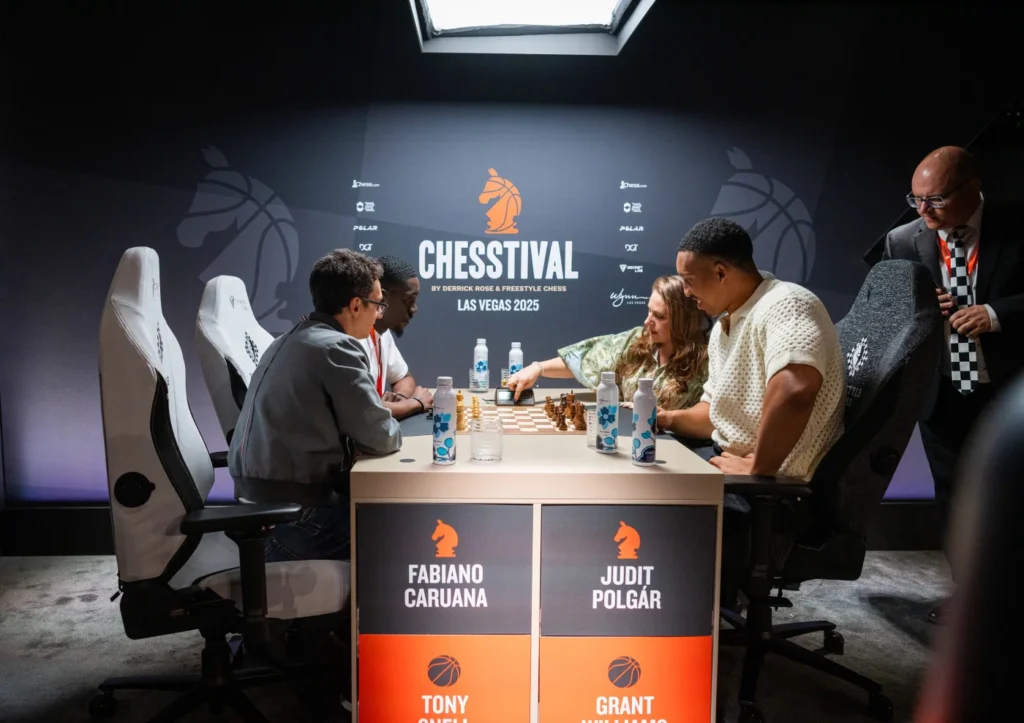
The concept of randomising chess has historical roots, but its modern codification and popularity are inextricably linked to two iconic world champions. The legendary Bobby Fischer, disillusioned by what he saw as the memorisation-heavy nature of professional chess, formally proposed the variant in 1996, providing the clear rules that define it today. Decades later, reigning chess icon Magnus Carlsen became its most powerful evangelist. Frustrated by the intensive preparation required in classical matches, Carlsen championed Fischer Random as the superior format for showcasing true chess talent. His advocacy, combined with the entrepreneurial vision of German tech entrepreneur Jan Henric Buettner, catalysed the format’s current boom. Their collaboration birthed the Freestyle Chess Grand Slam, a series of elite tournaments featuring classical time controls and substantial prize funds, which has successfully positioned the variant at the pinnacle of the competitive circuit.
Given these powerful tailwinds, the future trajectory of Freestyle Chess points unequivocally toward sustained and growing popularity. Its core virtues – eliminating theoretical drudgery, rewarding creativity, and producing exciting games – resonate deeply with a generation of players and fans. As more top-level events are established and streaming platforms broadcast its unpredictable battles to a global audience, its profile will only expand. Freestyle Chess does not seek to replace the classical game but rather to exist alongside it as a compelling and rigorous alternative. By returning the focus to in-the-moment brilliance over pre-game preparation, it offers a vibrant pathway for chess to evolve, ensuring its relevance and excitement for centuries to come.